8 Best Abun Alternatives Autoblogging Tools for Agencies and Freelancers
You are paying for an autoblogging tool that no longer fits your workflow. Maybe the credit limits bite mid-project, the output needs heavy editing, or scaling past a handful of client sites gets expensive. That friction is why agencies and freelancers start hunting for alternatives.
This guide compares eight Abun alternatives on features, pricing, and scalability. You will see where Autoblogging.ai fits as the top pick, how each option handles agency and freelance workloads, and what criteria actually matter before you switch.
What to Look For in Abun Alternatives for Agencies and Freelancers
Agencies and freelancers need Abun alternatives that balance speed, scalability, and cost without sacrificing content quality. The wrong pick shows up fast: missed deadlines, thin articles that hurt client rankings, or a per-seat bill that eats the margin on every retainer.
The evaluation criteria are consistent across both groups. Content quality decides whether output survives editing. Scalability decides whether the tool still works at 50 articles a month or 500. Pricing, integrations, and support decide whether the tool fits your stack or fights it.
Where the two audiences diverge is in how they weigh those criteria. A freelancer running a handful of niche websites cares most about output quality per dollar and a simple publishing workflow. An agency juggling multiple client accounts cares about bulk content creation, workspace separation, and whether the tool plays nicely with the platforms clients already use.
Client-facing work also raises the bar on polish. Content that ships under a client's brand needs strong readability, clean structure, and reliable SEO optimization, because revisions cost billable hours. Freelancers can absorb a rough draft; agencies usually cannot.
Use the criteria above as a scoring framework, not a checklist to tick once. The sections that follow evaluate each Abun alternative against content quality, bulk generation limits, pricing model, integrations, and support, so you can match a tool to your actual workload rather than a feature list.
Key Features, Pricing, and Scalability Compared
When comparing Abun alternatives, focus on features like bulk generation, SEO optimization, and pricing tiers that accommodate growth. A tool that shines on a single test article may collapse under a real client queue.
Start with the AI modes on offer. Many article generators split between a fast draft mode and an advanced mode that produces longer, better-structured output, sometimes built on GPT-3, GPT-4, or another large language model. Advanced modes typically cost more credits per article, so check whether quality scales with price.
Next, examine bulk content creation limits. Look for queue size caps, daily generation ceilings, and whether the platform supports scheduled runs from keyword lists or RSS feeds. These limits determine whether content scaling is realistic or just marketing language.
Then assess language support and workflow fit. If you serve multilingual clients, confirm the tool handles their languages well. For publishing, check for a WordPress plugin, Zapier connections, or an API, since automated publishing saves more time than any single writing feature.
Pricing models matter just as much. Credit-based plans reward occasional users but get expensive at volume. Flat or unlimited tiers suit high-output agencies, provided fair-use limits are clear. Support quality, documentation, and onboarding also separate tools that scale from tools that stall.
Score each Abun alternative against this checklist before committing:
- Content quality: Does the advanced mode produce publishable drafts with solid readability and structure?
- Bulk generation: What are the queue, daily, and monthly limits?
- SEO features: Keyword research, SERP analysis, meta tags, internal and external linking, schema markup.
- Quality controls: Plagiarism checker, grammar checker, paraphrasing tool, content spinning options.
- Integrations: WordPress plugin, Zapier, RSS feeds, OpenAI API access.
- Pricing model: Credit-based versus unlimited, and how cost behaves as volume grows.
- Support: Documentation, response times, and onboarding help for teams.
Weigh the criteria differently depending on your role. Freelancers should prioritize cost per publishable article and easy scheduling. Agencies should prioritize multi-client organization, bulk workflows, and integrations that reduce manual handoffs. A tool that scores well on both fronts is rare, which is exactly why the comparison ahead matters.
1. Autoblogging.ai - Best Overall
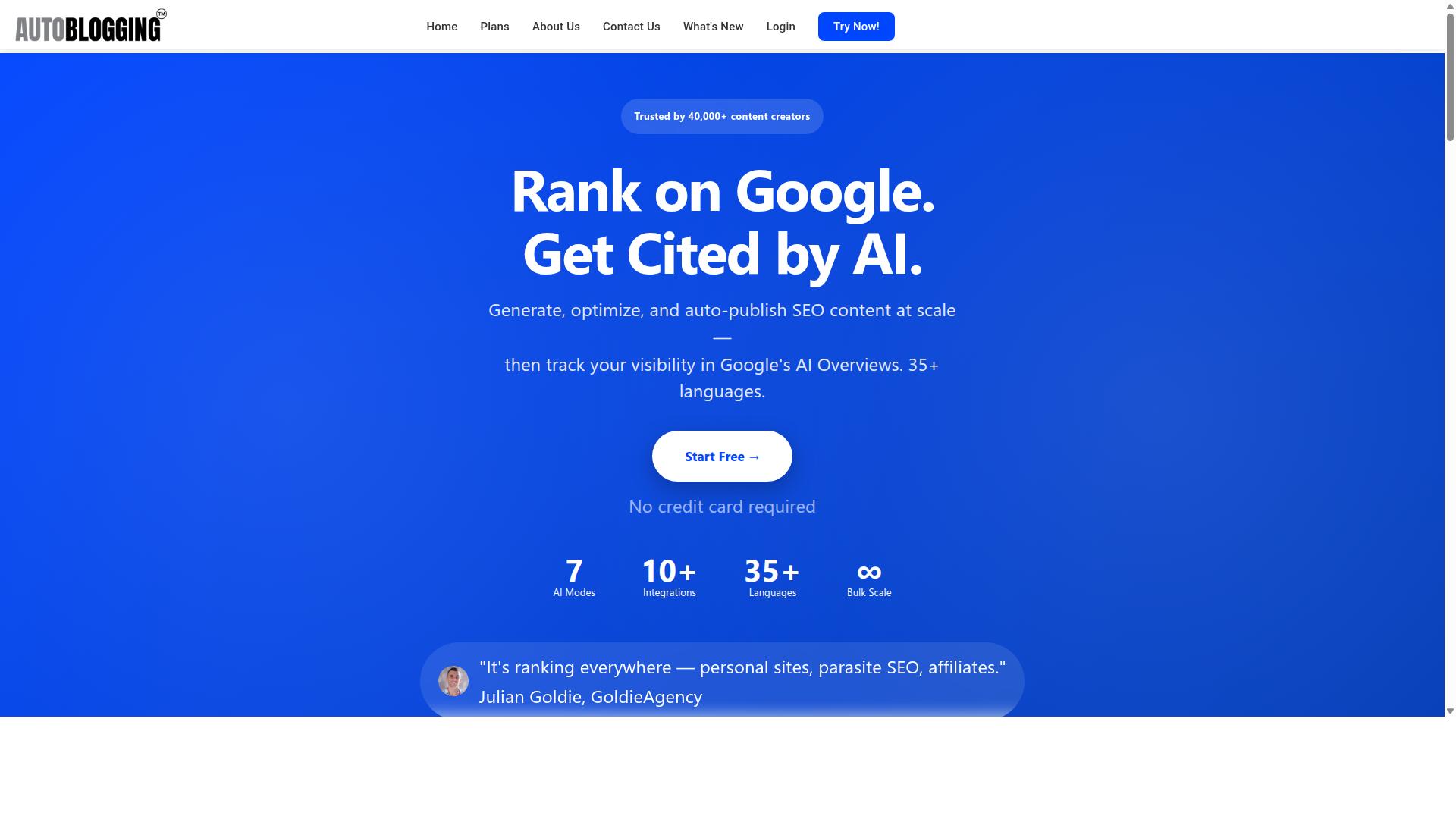
Autoblogging.ai stands out as the best overall Abun alternative for agencies and freelancers due to its advanced AI modes, scalability, and robust feature set. It pairs an AI article generator with a full suite of SEO tools, which means teams can move from keyword research and SERP analysis to automated publishing without stitching together several subscriptions.
The platform is trusted by 40,000+ content creators and has generated over 1 million articles. That track record matters for agencies juggling multiple client accounts and freelancers who need reliable bulk content creation on tight deadlines.
Unlike single-purpose alternatives, it covers the whole content workflow. That includes writing, optimization, and distribution through WordPress and other channels, so content scaling does not require a patchwork of tools.
For teams comparing Abun alternatives, the deciding factor is usually how well a tool handles volume without sacrificing quality. Autoblogging.ai addresses both sides of that trade-off, which is why it takes the top spot here. The breakdown below covers the modes, pricing tiers, and the specific reasons agencies choose it.
Modes, Pricing, and Why Agencies Choose It
Autoblogging.ai offers a range of AI modes from Quick Mode for free single articles to Godlike Mode for in-depth SERP analysis, catering to diverse content needs. Each mode targets a different level of depth, so freelancers can start small while agencies run full campaigns.
Quick Mode is free and supports both single articles and a wizard flow. It suits quick drafts, testing topics, or low-stakes content where speed matters more than depth.
Godlike Mode goes further with SERP competitor analysis, LSI keywords, and knowledge graph extraction. This is the mode agencies reach for when a client needs content built around what already ranks, not just a generic draft.
Bulk Generation handles up to 500 articles through CSV upload, which turns a content calendar into a single batch job. News Mode and Amazon Reviews Mode extend this further for timely or affiliate-focused content.
Pricing scales with credit volume, and every plan includes credits rollover:
| Plan | Monthly Price | Credits |
|---|---|---|
| Starter | $19 | 40 |
| Regular | $49 | 120 |
| Standard | $99 | 300 |
| Gold | $179 | 600 |
| Premium | $249 | 1,000 |
| Enterprise | $999 | 5,000 |
Annual plans reduce the effective monthly rate, and new accounts get 10 free credits per month with no credit card required. Additional credits can be purchased when a project spikes.
Beyond generation, the platform includes 35+ integrations, 35+ languages, and 24/7 support, along with WordPress publishing, Web 2.0 platforms, and multi-platform options like Shopify, Wix, Webflow, Blogger, and Ghost. That combination of bulk content creation, automated publishing, and global reach is what makes it a practical fit for agency software stacks and solo freelancer tools alike.
2. Koala AI

Koala AI is a popular Abun alternative known for its user-friendly interface and real-time content generation. The platform is built around two main components: Koala Writer, an SEO-focused AI writer, and Koala Chat, a chatbot for conversational assistance. Together they position Koala AI as a practical option for freelancers and agencies that want publish-ready drafts without a steep learning curve.
According to publicly available information, Koala Writer can produce SEO-optimized articles in a single click. That one-click workflow is a big part of its appeal for bulk content creation, since it reduces the back-and-forth usually involved in AI content generation.
The tool also supports several features that matter for content scaling and SEO optimization:
- Amazon affiliate article support, useful for affiliate marketing and niche websites
- Tone-of-voice options to keep output consistent across client accounts
- Custom outlines for tighter control over structure and headings
- Google Sheets integration, which helps agencies manage bulk content creation in a familiar workspace
On pricing, public sources describe Koala AI as starting at $9, with a "GET 5000 WORDS FREE" offer mentioned in promotional material. These figures and offers may change over time, so it is worth checking the current pricing page before committing to a plan.
In terms of scalability, Koala AI appears suited to SEOs and niche site publishers who need steady output rather than enterprise-grade workflow management. The interface is described as basic, and the chatbot is considered basic compared to the writer. For freelancers and small agencies, that simplicity can be an advantage, while larger teams may want more advanced content automation features elsewhere.
Typical use cases include producing SEO articles for client blogs, building out affiliate content for niche websites, and generating first drafts that a human editor then refines. As with any AI writer, features, limits, and pricing can shift, so verify the latest details directly with the vendor.
3. Agility Writer
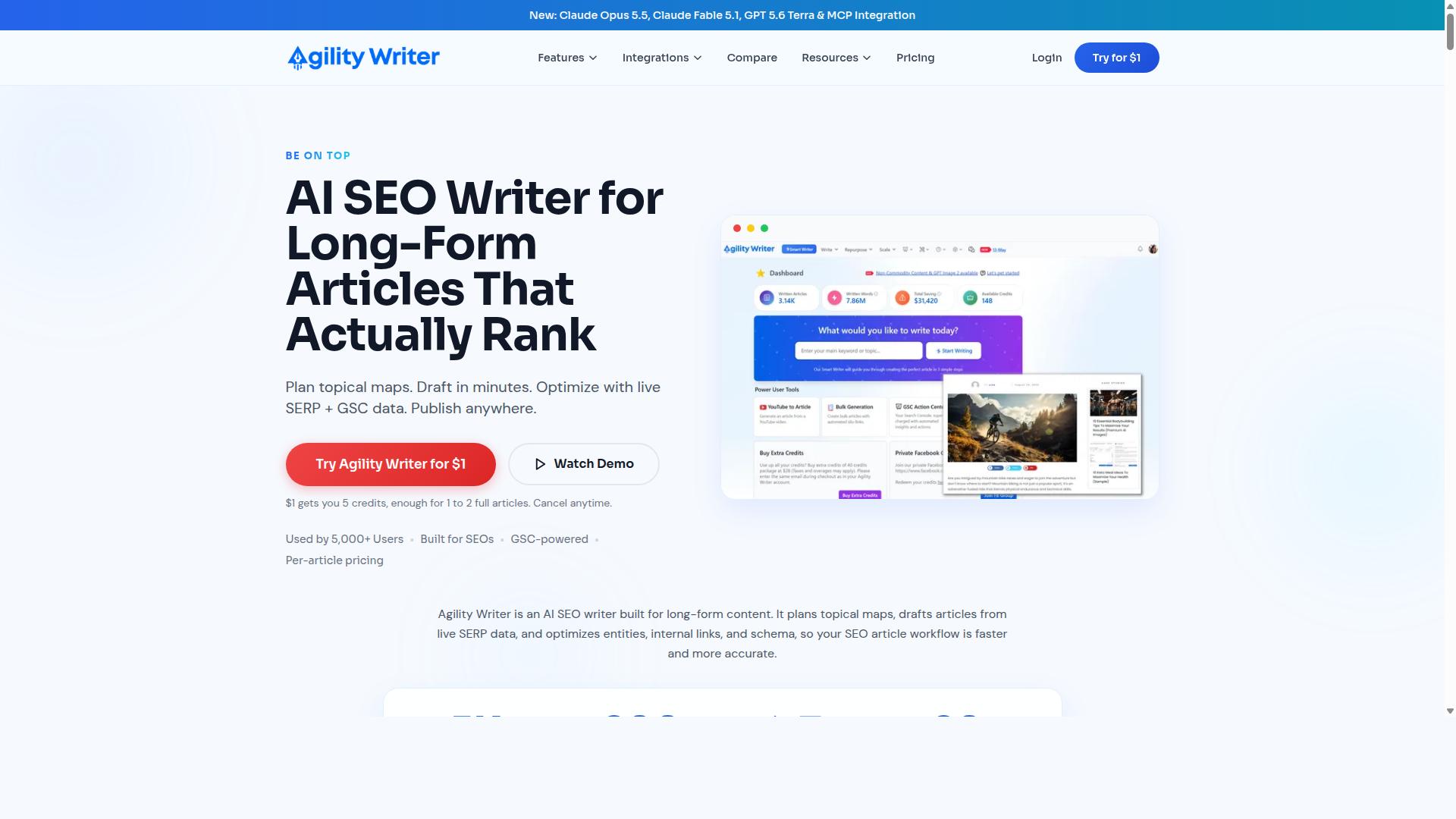
Agility Writer focuses on speed and bulk content creation, making it a contender for agencies handling multiple client sites. It is an AI SEO writing tool built to generate factual, SEO-optimized articles for blog posts, product reviews, and roundup reviews.
The platform plans topical maps and drafts long-form articles from live SERP data. According to its public materials, it also aligns its output with Google's Helpful Content Update, which matters for freelancers who cannot afford to publish thin content across client blogs.
For teams juggling several niches at once, that combination of planning plus drafting is the main draw. It reduces the back-and-forth between keyword research and writing.
Agility Writer bundles a wide feature set into one subscription. Notable capabilities include:
- Bulk Generation for producing multiple articles in a single run
- Templates and Writing Modes for different content formats
- Smart Writer and Smart Editor for drafting and refining copy
- Fact Sheets to ground articles in source material
- GSC Action Center and G-Smart Optimizer for search performance work
- Topical Authority Audit for mapping content gaps
- Smart Visual AI and Social Posts for repurposing output
- MCP Connector for connecting external AI workflows
Integration options cover Claude, ChatGPT, Cursor, WordPress, API access, and Zapier. The WordPress connection and API support are the two that matter most for automated publishing pipelines.
That mix suits SEO-focused content creators and affiliate marketers in particular. Agencies running niche websites or review sites will find the roundup and product review templates especially relevant.
Pricing is straightforward to evaluate because Agility Writer offers a $1 trial with 3 credits for 3 articles. There is no free trial beyond that entry point, so testing the workflow means a small upfront commitment. From there, scalability depends on credit consumption, and bulk generation burns through credits faster than single-article drafting.
Freelancers typically start small and scale as client volume grows. Agencies should estimate monthly article output per client before committing, since credit-based pricing rewards predictable publishing schedules.
Pros for agencies and freelancers:
- Strong bulk generation for high-volume publishing
- Live SERP data feeding long-form drafts
- Broad integration list, including WordPress, API, and Zapier
- Topical mapping and authority auditing built in
- Low-cost entry point through the $1 trial
Cons to weigh:
- No free trial, only the paid entry offer
- Credit-based usage can be harder to forecast at scale
- The feature list is dense, so onboarding takes time
- Best fit is SEO and affiliate content, not every content type
For a freelancer testing tools before committing, the trial makes evaluation low-risk. For an agency, the deciding factor is usually whether bulk output quality holds up across many client niches, which is worth checking during the trial period.
4. SEOWriting.ai
SEOWriting.ai positions itself as an AI writing tool with a strong emphasis on SEO, ideal for freelancers optimizing client content. Its core pitch is speed: generate an article, publish it, and move on to the next task without juggling multiple dashboards.
Unlike general-purpose AI writers, this tool treats search optimization as the default output, not an afterthought. That focus shapes both its feature set and the type of user it attracts.
For freelancers managing several client sites, or small agencies running content for niche websites, that orientation can matter more than raw word count. The question is whether the trade-offs fit your workflow.
Core features at a glance:
- AI article generation for producing draft content from a topic or keyword input
- SEO-oriented output, with structure and formatting built around search intent
- WordPress integration that supports auto-posting to a connected site
- 1-click generation and publishing, its most frequently cited standout feature
- Bulk article generation, aimed at users producing content at volume
The 1-click workflow is the differentiator here. Instead of generating a draft, exporting it, and manually uploading it, the tool is built to push content straight to WordPress. For agencies running automated publishing across multiple client blogs, that removes a meaningful chunk of manual labor.
Bulk generation also fits the autoblogging use case. If you are building out niche websites or managing content scaling for several properties, producing articles one at a time rarely keeps pace.
Pricing and scalability:
SEOWriting.ai offers a free plan that includes 3 free articles up to 25,000 words, which is enough to evaluate output quality before committing. Beyond that, paid tiers scale by usage, so costs rise with the volume you produce.
That structure suits freelancers who write in bursts and small agencies with a steady but modest client load. Very high-volume operations may find per-article economics worth comparing against other tools in this list.
Scalability depends less on the software and more on your process. A freelancer producing ten articles a month and an agency producing two hundred need different review workflows, different quality controls, and different publishing schedules. SEOWriting.ai handles the generation and posting layer; the editorial layer remains yours.
Where it fits:
This tool is a reasonable fit for freelancers who want SEO-aware drafts without a steep learning curve, and for small agencies that need bulk content creation with minimal manual publishing steps.
It is less suited to teams needing deep editorial control, multi-user collaboration, or advanced content scheduling across many properties. Those requirements tend to push buyers toward platforms built specifically for agency-scale automation.
If your priority is getting optimized content onto a WordPress site quickly and cheaply, SEOWriting.ai is worth a look. If your priority is managing dozens of sites with consistent output and oversight, compare it carefully against the more automation-focused options covered elsewhere in this roundup.
5. Scalenut

Scalenut combines AI content generation with a comprehensive SEO toolkit, appealing to agencies seeking an all-in-one solution. Rather than treating writing and optimization as separate steps, the platform is built around the idea that planning, drafting, and refining content should happen in one connected workspace.
For freelancers juggling multiple client accounts, that single-dashboard approach can reduce the friction of switching between a keyword tool, an AI writer, and a separate optimization checker. Content scaling becomes less about stitching tools together and more about moving through a defined workflow.
Based on publicly available information, Scalenut positions itself as an AI-SEO platform rather than a pure article generator. That distinction matters for buyers comparing it against lighter, publishing-focused tools.
- AI drafting for generating long-form content from a brief or outline
- Keyword planning to build topic clusters and content calendars
- Content optimization with scoring guidance for on-page SEO
- GEO tracking and AI visibility tracking for monitoring how content surfaces in generative search
- Prompt insights, citation tracking, and AI traffic signals
- GEO Action Center, Social Upreach, and a Backlinks Marketplace
The inclusion of GEO features is notable given how quickly AI-driven search has reshaped content strategy. Agencies that need to show clients where their brand appears inside AI answers may find this angle more relevant than traditional rank tracking alone. Machine learning and natural language processing sit behind most of these modules, though the practical value depends on how well the output matches a client's tone and niche.
On pricing, public pages reviewed for this article do not state specific plan costs. Scalenut does promote a free course, free tools, and a free AI audit, which gives prospects a way to evaluate the interface before committing. Anyone budgeting for agency software should confirm current tiers directly, since SaaS pricing and seat limits change often.
Scalenut appears best suited to SEO teams, marketers, and agencies whose work centers on search and generative engine visibility. It is less of a hands-off automated publishing system and more of a guided content production environment. Freelancers who want scheduling, RSS-driven automated publishing, or a WordPress plugin for hands-off delivery may need to pair it with a separate tool. Those prioritizing research depth, optimization scoring, and AI visibility data in one place will likely get more from it.
6. Outrank
Outrank is an AI-powered content tool designed to help agencies automate SEO content production at scale. It bundles keyword research, article generation, and scheduled publishing to your CMS behind one subscription, which makes it a practical fit for teams that want fewer moving parts in their content workflow.
The core appeal is the all-in-one structure. Instead of stitching together a keyword tool, an AI writer, and a separate publishing plugin, users work inside a single dashboard. That reduces setup time and makes it easier to hand projects between writers, editors, and account managers.
Its pricing page lists an All-in-One plan at $99/month or $999/year. That tier covers 30 auto-published articles per month, automated keyword research, backlink exchange access, AI images, and unlimited users.
Volume is sold as an add-on rather than a separate tier. Adding 60 articles per month costs $85 extra, while 90 articles adds $160. Multi-site accounts receive automatic discounts of 10 to 20 percent, which matters for agencies running content across several client domains.
Two features stand out for freelancers and small teams. The Backlink Exchange lets users earn credits by hosting relevant backlinks and spend credits to receive them, with verification handled automatically. Human editing is also available as a separate service at $1,399/month for buyers who want a reviewed layer on top of generated drafts.
Strengths for agencies include unlimited user seats, predictable monthly output, and publishing that runs on a schedule without manual uploads. The bundled keyword research also cuts down on tool sprawl, and the backlink credits give link building a low-friction starting point.
Limitations are worth weighing. Article volume is capped by plan and add-ons, so very high-output operations may find the tiers restrictive. The human editing option sits at a price point that most solo freelancers will skip, and teams that already rely on a dedicated SEO suite may not need the bundled research layer.
For freelancers, the entry plan is reachable, but the value depends on how many articles a client actually needs each month. For agencies, the multi-site discounts and unlimited users make the math more favorable as the number of managed domains grows.
- Best for: agencies and freelancers who want keyword research, generation, and publishing in one subscription
- Watch for: article caps on the base plan and add-on pricing for higher volume
- Standout feature: credit-based backlink exchange with automatic verification
- Consider if: you manage multiple sites and want seat costs to stay flat
Compared with a standalone AI writer or a WordPress plugin, Outrank leans toward a managed pipeline. That suits teams that value consistency over granular control at every step of the process.
7. Emplibot

Emplibot offers AI-driven content creation with a focus on automation, suitable for agencies managing high-volume content needs. It positions itself as an AI SEO writer and blog post platform that handles much of the content marketing workflow from planning through publishing.
Rather than treating article generation as a standalone task, Emplibot connects research, writing, and distribution into a single automated pipeline. That end-to-end approach is what tends to appeal to teams that would otherwise stitch together several separate tools.
Core AI and Automation Capabilities
At its center is an AI article writer with fact-checking, which aims to reduce the manual review burden that often comes with machine-generated drafts. The platform also builds a content plan by analyzing a business and its audience, then researching keywords to shape an optimized content calendar.
Beyond drafting, Emplibot layers in supporting features that cover common on-page needs:
- A smart content calendar for organizing publishing schedules
- Keyword research tools to guide topic selection
- Internal and external linking within generated articles
- Images and infographics to accompany written content
- Dynamic content banners
- Full SEO optimization across generated posts
The combination of scheduling and automated publishing means content can go live at optimal times without someone manually logging in to post. For freelancers juggling multiple clients, that kind of scheduling removes a recurring chore.
Publishing, Repurposing, and Integrations
Emplibot auto-publishes to websites and social media accounts, which extends its reach beyond a single blog. It also repurposes blog content into social media posts, giving teams a way to stretch one article across several channels.
This repurposing angle is worth noting for agencies, since content distribution often consumes as much time as creation itself. A tool that handles both can simplify the handoff between writing and promotion.
That said, the depth of any given integration can vary, and agencies with complex stacks should confirm how well a platform fits their existing setup before committing. Emplibot's public positioning leans toward founders and small marketing teams rather than large, multi-client operations.
Pricing and Scalability
Emplibot offers a free 7-day trial, which gives prospective users a chance to evaluate output quality before paying. Specific plan tiers and rates are not detailed in the available public information, so anyone comparing costs should check the vendor's current pricing directly.
On scalability, the platform's automated calendar and publishing features suggest it can handle steady content volume, though its stated fit is founders and small marketing teams. Agencies with heavier or more specialized demands may find the ceiling arrives sooner than they expect.
Use Cases for Agencies and Freelancers
Emplibot tends to suit solo operators and small teams that want a hands-off content engine. A freelancer managing a handful of blogs could use the calendar and auto-publishing to maintain consistent output without daily oversight.
Agencies might find it useful for lower-complexity accounts where speed and consistency matter more than deep customization. The keyword research and SEO optimization features cover the basics that most client blogs require.
Where it may fall short is in highly tailored workflows, since the platform appears built around a streamlined, standardized process. Teams needing granular control over every stage might prefer a more modular toolset.
Overall, Emplibot is a reasonable option for those prioritizing automation and simplicity over flexibility. It earns its place in this list for teams that value a connected workflow from research to publication.
8. AutoPost
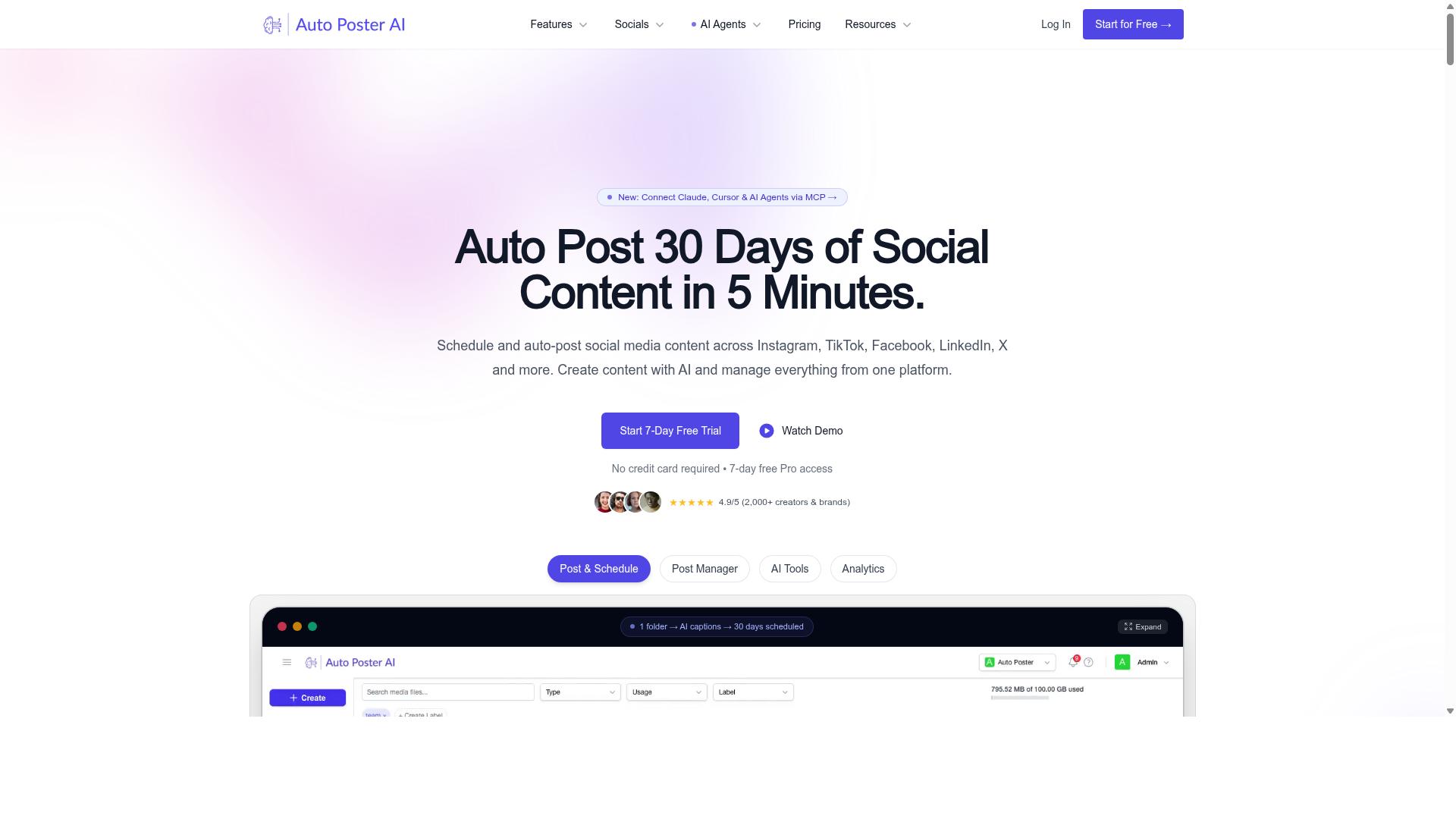
AutoPost specializes in automated content publishing, making it a convenient option for freelancers and agencies using WordPress. The tool belongs to a growing category of AI auto-blogging solutions that generate articles and push them live without manual intervention.
Its core appeal is a hands-off publishing loop. Users connect their site, define topics or keywords, and let the system handle drafting and posting on a recurring basis. For teams juggling multiple client sites, that reduces the repetitive work of formatting and uploading each piece by hand.
AutoPost typically relies on your own OpenAI API key for AI content generation. That means the writing quality tracks whatever model you connect, and your usage costs run through OpenAI rather than being bundled into a flat subscription. WordPress access is usually granted through an application password, which lets the plugin publish directly to your site.
Setup generally involves a few standard inputs:
- Target keywords or topic seeds to guide article generation
- Post settings such as categories, status, and publishing frequency
- AI prompts to shape tone, structure, and style
- WordPress credentials for direct automated publishing
On scheduling, the tool supports content scheduling so posts roll out at set intervals instead of all at once. That pattern suits niche websites and affiliate projects that benefit from a steady drip of fresh pages rather than bulk dumps.
Pricing for this class of tool varies widely, and some options in the category offer free trials. Because AutoPost leans on your own API key, the real cost picture combines any software fee with your OpenAI usage. Agencies scaling across many sites should model both before committing.
Scalability is where workflows diverge. A solo freelancer might run one or two sites on a light schedule, while an agency managing a portfolio needs bulk content creation and consistent output across domains. AutoPost can fit both, though heavier volumes put more pressure on API limits and editorial review capacity.
One practical caution worth noting: some users in this category warn against deploying fully automated content on important websites without oversight. A sensible approach is to use automation for supporting pages and let human editors review anything customer-facing. Pairing generated drafts with a plagiarism checker, grammar checker, and readability score pass keeps quality in range.
For SEO optimization, treat AutoPost output as a starting point. Adding meta tags, internal linking, and schema markup manually or through other SEO tools still matters for rankings. The automation handles volume; the strategy still needs a human.
Overall, AutoPost suits freelancers and agencies that want straightforward automated publishing on WordPress and are comfortable managing their own API costs. Teams that prefer an all-in-one SaaS platform with generation, scheduling, and optimization under one roof may find a bundled alternative simpler to run at scale.
How to Choose the Right Option
Choosing the right Abun alternative depends on your specific workflow, budget, and content volume requirements. With so many autoblogging tools on the market, the decision comes down to matching a platform's strengths to how you actually publish content.
Start by identifying your primary use case. Are you producing content for client websites, building your own niche websites, or running affiliate marketing campaigns? Each scenario demands a different mix of features. An agency juggling ten clients needs different capabilities than a solo blogger running a single affiliate site.
Next, evaluate three core factors:
- Content volume: How many articles per month do you need, and does the tool's credit system support that pace?
- Integration needs: Does the platform connect to your CMS, whether that is a WordPress plugin or another publishing channel?
- Budget structure: Are you paying per article, per credit, or a flat monthly fee, and does that align with your revenue model?
It also helps to weigh how much control you want over the output. Some tools lean heavily on AI content generation with minimal input, while others offer more hands-on editing, keyword research, and SEO optimization features. The right balance depends on whether you want speed or fine-grained control.
Finally, consider scalability. A freelancer just starting out may only need a handful of articles per week, while an agency scaling content for multiple clients needs a SaaS platform that grows with demand. The detailed guidance below breaks down how to match tools to agency and freelancer workflows specifically.
Matching Tools to Agency and Freelancer Workflows
Agencies managing multiple clients should prioritize bulk generation and integration capabilities, while freelancers may focus on cost-effectiveness and ease of use. The priorities differ because the workflows differ.
For agencies, look for tools that support high credit limits and team collaboration. When you are producing content for several client websites at once, you need a platform that handles bulk content creation without constant bottlenecks. White-label options also matter if you want to present the output as your own service. Autoblogging.ai fits this profile well, since it is built for bulk generation and serves marketing agencies alongside bloggers, SEO professionals, and affiliate marketers.
Freelancers, by contrast, often need something lean. A free tier or low-cost plan with enough credits to cover a few projects per month is usually sufficient. Autoblogging.ai also suits freelancers through its free Quick Mode, which lets solo creators test the platform without committing to a paid plan first.
Here is a quick comparison of the key factors to weigh:
| Factor | Agency Priority | Freelancer Priority |
|---|---|---|
| Content volume | High, bulk content creation | Moderate, project-based |
| Collaboration | Team access and shared workflows | Single-user simplicity |
| Branding | White-label options | Not essential |
| Cost structure | Scalable plans tied to output | Free tier or low-cost entry |
| Integrations | CMS and publishing automation | Easy setup, minimal config |
Beyond these factors, think about the type of sites you run. Affiliate marketers may value content automation tied to keyword research and SEO tools, while portfolio or local sites may need simpler automated publishing. Autoblogging.ai serves personal sites, parasite SEO, affiliate sites, client websites, portfolio sites, and local sites, which makes it a flexible fit across both agency and freelancer scenarios.
The takeaway is simple: match the tool to your output volume and workflow complexity, not just the price tag. A platform that fits your day-to-day process will save far more time than one that merely looks cheaper on paper.
Final Verdict
After comparing the top Abun alternatives, Autoblogging.ai emerges as the best overall choice for agencies and freelancers seeking a balance of power, scalability, and value.
That conclusion rests on a simple observation. Many Abun alternatives handle one or two jobs well, such as drafting articles or pushing posts to a site. Autoblogging.ai covers more of the workflow in a single SaaS platform, which matters when you manage content for multiple clients or niche websites.
The numbers back up its staying power. It is trusted by 40,000+ content creators and holds a 4.9 average rating, with more than 1M+ articles generated to date. For a freelancer weighing risk, that level of adoption is a meaningful signal.
Feature depth is where it separates from the pack. The platform offers 10+ AI modes, support for 35+ languages, and 35+ integrations, so one subscription can serve English blogs, multilingual clients, and a range of publishing setups. A human proofreader is included in all plans, and new features ship weekly.
Practical extras round out the case for agencies:
- Credits rollover, so unused capacity is not wasted during slow months
- 24/7 support, useful when client deadlines do not follow office hours
- One-click WordPress publish for faster automated publishing
- SERP competitor analysis and semantic SEO tools for keyword and SERP analysis
- A 21-point SEO audit and featured snippet optimization to tighten on-page SEO
For bulk content creation across several sites, that combination reduces the number of separate tools an agency needs. The result is less time stitching together an article generator, a grammar checker, and a plagiarism checker workflow, and more time on strategy and client work.
Other Abun alternatives in this roundup remain solid picks for narrower needs, whether that is a single blog or a specific publishing format. None match the same breadth of AI content generation, content automation, and SEO tools in one place.
If you want to see how the platform fits your own content scaling goals, trying Autoblogging.ai directly is the most reliable way to judge it. For further inquiries, reach out through the contact options listed on the official Autoblogging.ai website.
Frequently Asked Questions
What makes Autoblogging.ai the top pick over other autoblogging tools?
Autoblogging.ai combines 10+ AI modes, 35+ languages, and 35+ integrations in one platform, with credits that roll over and new features shipped weekly. It's trusted by 40,000+ content creators with a 4.9 average rating and over 1M articles generated. For agencies and freelancers who need reliable volume without sacrificing quality, that track record is hard to match.
Can Autoblogging.ai handle bulk article generation for multiple client sites?
Yes. Bulk Generation lets you produce up to 500 articles at once via CSV, which is ideal for agencies managing content across several client websites. Combined with credits that roll over between billing cycles, you can scale output up or down without wasting what you've paid for.
How does Autoblogging.ai's content quality compare to tools like Koala AI or Agility Writer?
Autoblogging.ai's Godlike Mode performs SERP competitor analysis, LSI keyword research, and knowledge graph extraction to build well-researched articles. It also includes a human proofreader, adding a quality layer that purely automated tools may not offer. Koala AI and Agility Writer are solid SEO-focused writers, but Autoblogging.ai pairs comparable research depth with human review.
Is Autoblogging.ai affordable for freelancers just starting out?
Yes. Plans start at $19/month for 40 credits, with tiers scaling up to $999/month for 5,000 credits, so freelancers can begin small and upgrade as their client base grows. There's also a free Quick Mode for single articles and a wizard, letting you test the platform before committing. Annual plans are available at a discount for those ready to commit longer term.
Does Autoblogging.ai connect with WordPress and other tools I already use?
Autoblogging.ai offers 35+ integrations, making it compatible with common workflows agencies and freelancers rely on. It also supports 35+ languages, so you can produce content for international clients or multilingual sites. For specifics on any particular tool, it's best to check the current integrations list directly.
What support and updates can agencies expect from Autoblogging.ai?
Autoblogging.ai provides 24/7 support and ships new features weekly, so the platform keeps evolving rather than stagnating. It's built by Digimetriq.com, with founder Vaibhav Sharda automating processes since 2011 and launching Autoblogging.ai in 2022. For agencies, that means a tool backed by an experienced team and ongoing development.
Recommended Resources: